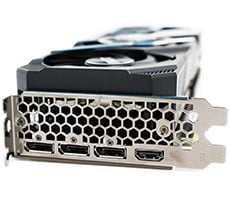
When we're asked by readers for hardware advice, one of the most popular topics involves the graphics card. With a myriad of options out there covering the price and performance spectrum, it's not always a cut and dried answer. First, we need to consider the person's budget requirements, then assess the rest of their hardware to see what best fits their situation. It's not simply a matter of buying the most expensive card one can afford. We wish it were that simple. In the end, it all comes down to a balancing act between price, performance, and user's particular configuration.
On the other hand, there are those who are less concerned with nickel and diming the process of buying a new video card and don't mind indulging themselves with a product that has a little extra panache. The Sapphire Radeon HD 3870 Toxic 512MB falls more inline with that kind of thinking. The "Toxic" model is a souped up Radeon HD 3870 that boasts a single slot Vapor-X cooler, which allows the card to be overclocked without the need for a dual-slot cooling solution. In the pages ahead, we'll assess the overall performance of the Sapphire Radeon HD 3870 Toxic 512MB edition and see how it compares with a pricier competitor and also see whether the "toxic" version makes the card more or less attractive from a price-to-performance perspective. Finally, we'll test the cooler even further to ascertain whether Sapphire left any more headroom for those looking to overclock the card even further.
|

|
|
Sapphire Radeon HD 3870 512MB Toxic |
|
Specifications and Features | |
| 666 million transistors on 55nm fabrication process
256bit 8-channel GDDR3/4 memory interface
Ring Bus Memory Controller
- Fully distributed design with 512-bit internal ring bus for memory reads and writes
- Optimized for high performance HDR (High Dynamic Range) rendering at high display resolutions
Unified Superscalar Shader Architecture
- 320 stream processing units
- Dynamic load balancing and resource allocation for vertex, geometry, and pixel shaders
- Common instruction set and texture unit access supported for all types of shaders
- Dedicated branch execution units and texture address processors
- 128-bit floating point precision for all operations
- Command processor for reduced CPU overhead
- Shader instruction and constant caches
- Up to 80 texture fetches per clock cycle
- Up to 128 textures per pixel
- Fully associative multi-level texture cache design
- DXTC and 3Dc+ texture compression
- High resolution texture support (up to 8192 x 8192)
- Fully associative texture Z/stencil cache designs
- Double-sided hierarchical Z/stencil buffer
- Early Z test, Re-Z, Z Range optimization, and Fast Z Clear
- Lossless Z & stencil compression (up to 128:1)
- Lossless color compression (up to 8:1)
- 8 render targets (MRTs) with anti-aliasing support
- Physics processing support
Full support for Microsoft DirectX 10 / 10.1
- Shader Model 4.0
- Geometry Shaders
- Stream Output
- Integer and Bitwise Operations
- Alpha to Coverage
- Constant Buffers
- State Objects
- Texture Arrays
Dynamic Geometry Acceleration
- High performance vertex cache
- Programmable tessellation unit
- Accelerated geometry shader path for geometry amplification
- Memory read/write cache for improved stream output performance
Anti-aliasing features
- Multi-sample anti-aliasing (up to 8 samples per pixel)
- Up to 24x Custom Filter Anti-Aliasing (CFAA) for improved quality
- Adaptive super-sampling and multi-sampling
- Temporal anti-aliasing
- Gamma correct
- Super AA (CrossFire configurations only)
- All anti-aliasing features compatible with HDR rendering
CrossFire Multi-GPU Technology
- Scale up rendering performance and image quality with 2 or more GPUs
- Integrated compositing engine
- High performance dual channel interconnect
PCI Express 2.0 x16 bus interface
OpenGL 2.0 support |
Texture filtering features
- 2x/4x/8x/16x high quality adaptive anisotropic filtering modes (up to 128 taps per pixel)
- 128-bit floating point HDR texture filtering
- Bicubic filtering
- sRGB filtering (gamma/degamma)
- Percentage Closer Filtering (PCF)
- Depth & stencil texture (DST) format support
- Shared exponent HDR (RGBE 9:9:9:5) texture format support
ATI Avivo HD Video and Display Platform
- Two independent display controllers
- Drive two displays simultaneously with independent resolutions, refresh rates, color controls and video overlays for each display
- Full 30-bit display processing
- Programmable piecewise linear gamma correction, color correction, and color space conversion
- Spatial/temporal dithering provides 30-bit color quality on 24-bit and 18-bit displays
- High quality pre- and post-scaling engines, with underscan support for all display outputs
- Content-adaptive de-flicker filtering for interlaced displays
- Fast, glitch-free mode switching
- Hardware cursor
- Two integrated dual-link DVI display outputs
- Each supports 18-, 24-, and 30-bit digital displays at all resolutions up to 1920x1200 (single-link DVI) or 2560x1600 (dual-link DVI)
- Each includes a dual-link HDCP encoder with on-chip key storage for high resolution playback of protected content
- Two integrated 400 MHz 30-bit RAMDACs
- Each supports analog displays connected by VGA at all resolutions up to 2048x1536
- HDMI output support
- Supports all display resolutions up to 1920x1080
- Integrated HD audio controller with multi-channel (5.1) AC3 support, enabling a plug-and-play cable-less audio solution
- Integrated Xilleon HDTV encoder
- Provides high quality analog TV output (component / S-video / composite)
- Supports SDTV and HDTV resolutions
- Underscan and overscan compensation
- HD decode for H.264/AVC, VC-1, DivX and MPEG-2 video formats
- Flawless DVD, HD DVD, and Blu-Ray playback
- Motion compensation and IDCT (Inverse Discrete Cosine Transformation)
- HD video processing
- Advanced vector adaptive per-pixel de-interlacing
- De-blocking and noise reduction filtering
- Edge enhancement
- Inverse telecine (2:2 and 3:2 pull-down correction)
- Bad edit correction
- High fidelity gamma correction, color correction, color space conversion, and scaling
- MPEG-2, MPEG-4, DivX, WMV9, VC-1, and H.264/AVC encoding and transcoding
- Seamless integration of pixel shaders with video in real time
- VGA mode support on all display outputs
|
For some background details on the Radeon 3870, we suggest taking a look back at our launch article from when ATI first introduced their RV670 GPU. There is a detailed explanation of the GPU's architecture as well as thorough performance testing including noise and power consumption versus a slew of competitive products.