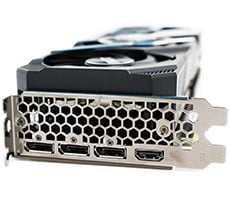


NVIDIA GeForce GTX 260 Core 216: EVGA, Zotac


Performance Summary: The new GeForce GTX 260 Core 216 performed very well throughout out entire battery of benchmarks. Overall, the GTX 260 Core 216 outperformed the first-gen GeForce GTX 260 in every test--as expected--and outpaced the Radeon HD 4870 in the vast majority of tests as well. The Zotac card we tested was marginally faster than EVGA's offering due to its slightly higher clock speeds, but the differences were small and could be made up for with some mild overclocking. In the multi-GPU tests, the GeForce GTX 260 Core 216 setup performed better than the Radeon HD 4870 CorssFire setup more often than not, but superior scaling in a couple of tests (3DMark06, HL2 1920x1200) gave the Radeons an edge.
It seems NVIDIA has done just what they intended to do with the GeForce GTX 260 Core 216. By upping the number of stream processors and texture filtering units in the GPU, they were able to increase the card's performance enough to give it a slight advantage over the Radeon HD 4870. We should reiterate that we tested a couple of factory overclocked cards, however, which give them a performance boost as well, so reference clocked GeForce GTX 260 Core 216 cards will not have as large of an advantage as we have reported here. Regardless, we've given you a look at the performance of the retail product, which is obviously what you should be concerned with more than any reference spec.

Reference GeForce GTX 260 Core 216 cards carry and MSRP of $279, which puts them somewhere in between 512MB and 1GB Radeon HD 4870 cards in terms of price. First-gen GeForce GTX 260 cards are already selling for about $235 on up (after MIR), so don't expect their prices to drop too much on today's news. Overclocked cards like the ones we have tested here will be somewhat more expensive, however, with MSRPs in the $299 - $329 range. Cards should be available in retail channels immediately.
It is a very interesting time in the GPU space. ATI owns the single-card leadership position with the Radeon HD 4870 X2 and has a killer value-priced product in the Radeon HD 4850, while NVIDIA holds the single-GPU leadership position with the GeForce GTX 280 and now surpasses the Radeon HD 4870 in the performance segment with the GeForce GTX 260 Core 216. NVIDIA also has the added benefit of supporting PhysX and CUDA, while ATI has support for DX 10.1. Choosing the right graphics card may be daunting for some, but the intense competition as of late has driven prices down considerably, which is undeniably a great thing for consumers. It is a great time to be in the market for a new graphics card, no matter what your budget and the new GeForce GTX 260 Core 216 underscores that nicely.